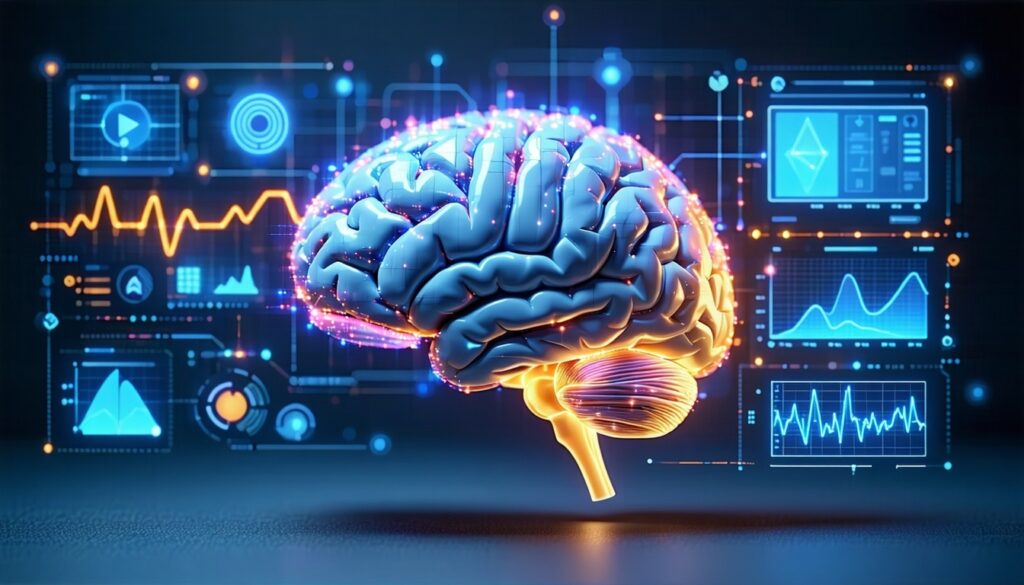
If you’re exploring new ways to enhance mental health treatment for yourself or a loved one, chances are you’ve heard about the EEG brain mapping test. This cutting-edge tool uses electrodes on your scalp to record your brain’s electrical signals, creating a “map” of activity patterns. The visuals help clinicians pinpoint atypical activity, giving them a clearer sense of what might be fueling your symptoms. Whether you receive care online or in person, this test can offer insights that transform your treatment plan. Below, we’ll talk about how EEG brain mapping works, what to expect from the process, and how it can fit into your overall care with MindHealth MD.
Discover EEG brain mapping test
EEG stands for electroencephalogram. It’s a non-invasive test that measures electrical impulses in your brain by placing small metal discs, often called electrodes, on your scalp [1]. While the word “electrodes” might sound intimidating, this process is painless. Think of it as gently attaching adhesive sensors to your skin, similar to wearing a swim cap. These electrodes capture real-time changes in your brain activity and send the information to a computer. From there, specialized software translates it into wavy lines or color-coded maps.
When we talk about an EEG brain mapping test, we’re typically discussing a more detailed analysis called quantitative EEG (QEEG). This allows clinicians to compare your brain’s electrical patterns with a database of typical “norms.” If your brain’s activity is underactive, overactive, or otherwise abnormal in certain areas, the QEEG helps highlight that. Sometimes, doctors will use routine EEG recordings that last 20 to 40 minutes. Other times, they’ll suggest an ambulatory EEG, which lets you go about daily life while the device records your brainwaves over hours or even days [2].
By identifying unusual activity, the EEG brain mapping test can shed light on epilepsy, seizure conditions, cognitive difficulties, and certain psychiatric disorders [3]. For many people, however, the test is about more than diagnosing a single issue. It’s a tool that helps you see how your brain processes information in various situations. That perspective can be a game-changer, particularly if you or your loved ones are looking for advanced care options like TMS, medication-assisted treatment (MAT), or telehealth psychiatry services.
Explore mental health benefits
You might be wondering: “So how does all this data from an EEG brain mapping test help me or a loved one?” The key is personalization. Traditionally, psychiatric treatments rely on clinical assessments. You discuss your symptoms, your behavior patterns, and your medical history, then your provider recommends a course of action. While this approach often works, there can be some trial and error in fine-tuning medication dosages or therapies.
Thanks to EEG mapping, clinicians can get a deeper look at your brain’s electrical patterns. If you’re struggling with conditions such as depression, anxiety, or post-traumatic stress disorder (PTSD), abnormal brain activity in certain regions might contribute to your symptoms. By analyzing which areas are firing too much or too little, your psychiatrist can develop a more accurate treatment plan. For instance, if your EEG results suggest a particular pattern related to treatment-resistant depression, you might be an ideal candidate for Transcranial Magnetic Stimulation. At MindHealth MD, you can schedule TMS treatment to see if gentle magnetic pulses offer relief when other methods have fallen short.
Similarly, the EEG approach can be a valuable addition if you’re looking into medication assisted treatment. MAT focuses on using FDA-approved medications to ease withdrawal symptoms or cravings. When combined with advanced brain-wave insights from an EEG, it’s often easier for your psychiatrist to monitor long-term improvements. If your brain activity calms in certain regions over time, your clinician has solid data to gauge medication effectiveness.
Beyond diagnosing and guiding treatments for depression, anxiety, or addiction, EEG can also illuminate how you respond to therapy. Are your brain’s stress or emotional regulation zones beginning to normalize? Are certain triggers still lighting up your brainwaves? The answers provided by an EEG test can help you and your care team make timely decisions about next steps. Plus, continuous monitoring can be done at home if you use an ambulatory setup. You’ll have the freedom to go about your day while capturing important data that reveals how your brain is functioning in natural environments.
Understand how it shapes care
Your brain’s electrical patterns can profoundly shape how you cope with stress, interpret emotions, and respond to medication. In mental health care, it’s important to match treatments as closely as possible to each unique situation. When you work with MindHealth MD, an EEG brain mapping test can serve as a blueprint. Just like an architect needs a sketch of a building before starting construction, your clinician benefits from a “map” of your brain before reinforcing or modifying various pathways.
-
• More accurate medication management. If your EEG results point toward hyperactive regions linked to anxiety or obsessive thought patterns, your doctor might focus on medications that reduce excitability in those zones. And if you’re dealing with substance cravings, the test might reveal specific regions that MAT can help regulate, making your mat for opioid addiction path more data-informed and precise.
-
• Better therapy alignment. Catching the underlying patterns of your brain’s activity can also inform talk therapy approaches. For example, if you have abnormal activity in regions associated with emotional processing, cognitive behavioral therapy (CBT) might be structured differently to address that. Over time, follow-up EEG sessions can confirm whether those interventions are successfully rebalancing your brain activity.
-
• Streamlined TMS planning. TMS is often recommended for individuals facing major depression who haven’t found enough relief from medication alone. Before beginning TMS, you might undergo an EEG brain mapping test to see if certain regions of the brain need more focused attention. Then TMS can be directed to those precise areas, boosting your chance of a positive response.
At home, EEG data might offer guidance for lifestyle adjustments. We all know sleep, nutrition, and stress management are important, but real-time data on your brain’s signals can highlight just how crucial they are. If the test shows spikes in stress-related patterns, for instance, your care team can emphasize stress-busting routines like mindfulness practice or gradually increasing physical activity.
Learn what to expect
Feeling nervous about brain tests is natural, but the EEG process is usually straightforward and comfortable. During a standard EEG, you’ll sit or lie down while a technician affixes electrodes to your scalp using an elastic cap or adhesive pads [1]. The setup takes a bit of time, since each electrode’s placement matters. Once things are in place, you’ll be asked to rest quietly. You might be asked to breathe deeply, close your eyes, and open them again to capture different brain states. In some cases, you may be asked to sleep or watch a flickering light that stimulates your brain’s response.
-
• Ambulatory EEG. If your doctor wants to capture a broader picture outside the office, you could be set up with a portable recorder for a day or more. This device is small enough to be worn on your waist or placed in a pocket, allowing you to continue daily activities while the system records your brainwaves. That means capturing more natural data for conditions like epilepsy, anxiety spikes, or recurring mood fluctuations [2].
-
• QEEG brain mapping. Here, the raw EEG data is processed through software that transforms the signals into color-coded maps. Your results might show red or orange in areas where your brain activity is higher than average, or blue where it’s lower. Your psychiatrist then interprets these visuals, paying attention to wave patterns (alpha, beta, delta, and theta) and how they compare to a typical brain’s activity. If you see unusual spikes, it might indicate an imbalance that correlates with certain symptoms, such as racing thoughts or difficulty concentrating.
-
• Safety and comfort. Whether you’re in a clinic or at home, EEG is non-invasive and painless. In rare instances, people with epilepsy might experience triggered seizure events, which are closely monitored by medical staff [1]. For most individuals, the procedure is about as low-risk as it gets, with minimal side effects aside from mild scalp irritation from the electrode gel.
After the test, a neurophysiologist or psychiatrist trained in EEG interpretation will review your data. You’ll schedule a visit to go over your results and discuss how they might influence your care plan. If improvements can be made—for example, adjusting a medication dosage or fine-tuning therapy sessions—this discussion provides clarity on next steps.
Choose MindHealth MD today
MindHealth MD is dedicated to offering comprehensive mental health care that goes beyond quick fixes or guesswork. Whether you need a telepsychiatry appointment for convenience, or you’re addressing deeper concerns like addiction or treatment-resistant depression, our providers are here to help. The EEG brain mapping test is one of the advanced diagnostic tools available. Here’s why it matters:
-
◦ Precision in diagnosis. Our clinicians interpret your EEG results alongside your personal history so you’re not just getting a generic label. It’s about seeing the full picture: brain activity, symptoms, stressors, and life circumstances.
-
◦ Tailored medication plans. If you’re juggling multiple medications, it can be challenging to figure out what’s working. EEG-based insights might reduce your trial-and-error phases.
-
◦ Seamless integration of TMS and MAT. We offer tms therapy for depression and mat for alcohol dependency. With EEG data, we can confirm whether these approaches align with your specific brain patterns. This alignment can mean quicker relief, fewer side effects, or a refined therapy schedule.
-
◦ Virtual care options. Maybe you can’t easily travel or need consistent support while balancing family and work responsibilities. Believe it or not, some EEG setups allow partial at-home use, making it simpler to incorporate diagnostic steps into your routine. Plus, everything from consultation to follow-up can be handled through a virtual psychiatry session.
-
◦ Ongoing support. EEG brain mapping doesn’t have to be a one-time thing. If you’re adjusting your care plan, a follow-up test might reveal whether your brain activity is shifting toward a healthier state. You’ll have real-time proof that your treatment, be it TMS, MAT, or therapy, is making a difference.
Because we embrace innovation, MindHealth MD can coordinate your EEG test and interpret the data efficiently. Should you need other forms of diagnostic support, like an EMG for muscle-related concerns, we can refer you to the right specialists. By bringing the best technology and a caring team together, we empower you to take meaningful steps for your mental health.
FAQs about EEG brain mapping
-
Is the EEG brain mapping test painful?
Not at all. Most people feel slight pressure when the adhesive discs or cap is placed on their scalp, but there are no needles or injections involved. If anything, you might just notice a bit of coolness from the gel used to improve the electrode connection. -
How long does it take to complete an EEG brain mapping session?
A routine EEG session can last from 20 to 40 minutes, plus set-up time. If you need an ambulatory EEG, you might wear the device for a day or more to track longer-term activity. The detailed QEEG analysis usually happens afterward, once the raw data is processed by specialized software. -
Can the EEG brain mapping test replace other brain scans like an MRI?
Not exactly. An MRI reveals the structure of your brain (looking for tumors or structural abnormalities), while an EEG focuses on the electrical activity. In some cases, your doctor may need both. MRI can show a physical lesion, whereas an EEG helps reveal functional issues that might still cause significant symptoms without any structural changes. -
Do I need sedation or special preparation for my EEG test?
You typically don’t need sedation. The process is safe and comfortable as is. Your clinician might have you avoid caffeine before the test or ask you to adjust certain medications, but they’ll let you know in advance. When you schedule an EEG with MindHealth MD, you’ll get clear pre-test instructions so you feel fully prepared. -
Who should consider an EEG brain mapping test?
If you or a loved one is navigating complex mental health concerns—such as anxiety, depression, addiction, or a suspected seizure disorder—an EEG can provide in-depth information about what’s happening under the surface. Even if you’ve tried other treatments, EEG data might reveal key insights that help your psychiatrist refine your care plan, from psychiatric medication management to specialized therapies like TMS.
Summary and next steps
An EEG brain mapping test doesn’t just measure electrical signals; it paints a window into your brain’s unique conversation patterns. For individuals grappling with long-standing depression, addiction, or other mental health challenges, that window can guide better treatment decisions. Instead of blindly testing new meds or therapy strategies, you can lean on data that illuminates which areas of your brain need extra support.
If you’re looking for a comprehensive approach that prioritizes precision and personalization, consider connecting with the team at MindHealth MD. We offer advanced evaluations to pinpoint how medication, TMS, or therapy may perform best in your situation. We can also integrate this data with your broader story—life stressors, daily routines, and overall mental health goals. From the comfort of your home, you can book an eeg diagnostic for mental health or set up a telepsychiatry appointment if you prefer a virtual approach.
There’s no need to guess which treatment might work best. Let the EEG brain mapping test be your guide, shining a spotlight on the root causes behind your symptoms. Whether you’re seeking help for yourself or your loved one, our goal is straightforward: provide the clarity you deserve so you can tap into meaningful, evidence-based care. Feel free to book psychiatric appointment whenever you’re ready to take the next step. You’re not alone, and with the right insights, better mental health is within reach.
References
- (Mayo Clinic)
- (NHS)
- (Radius TBI)